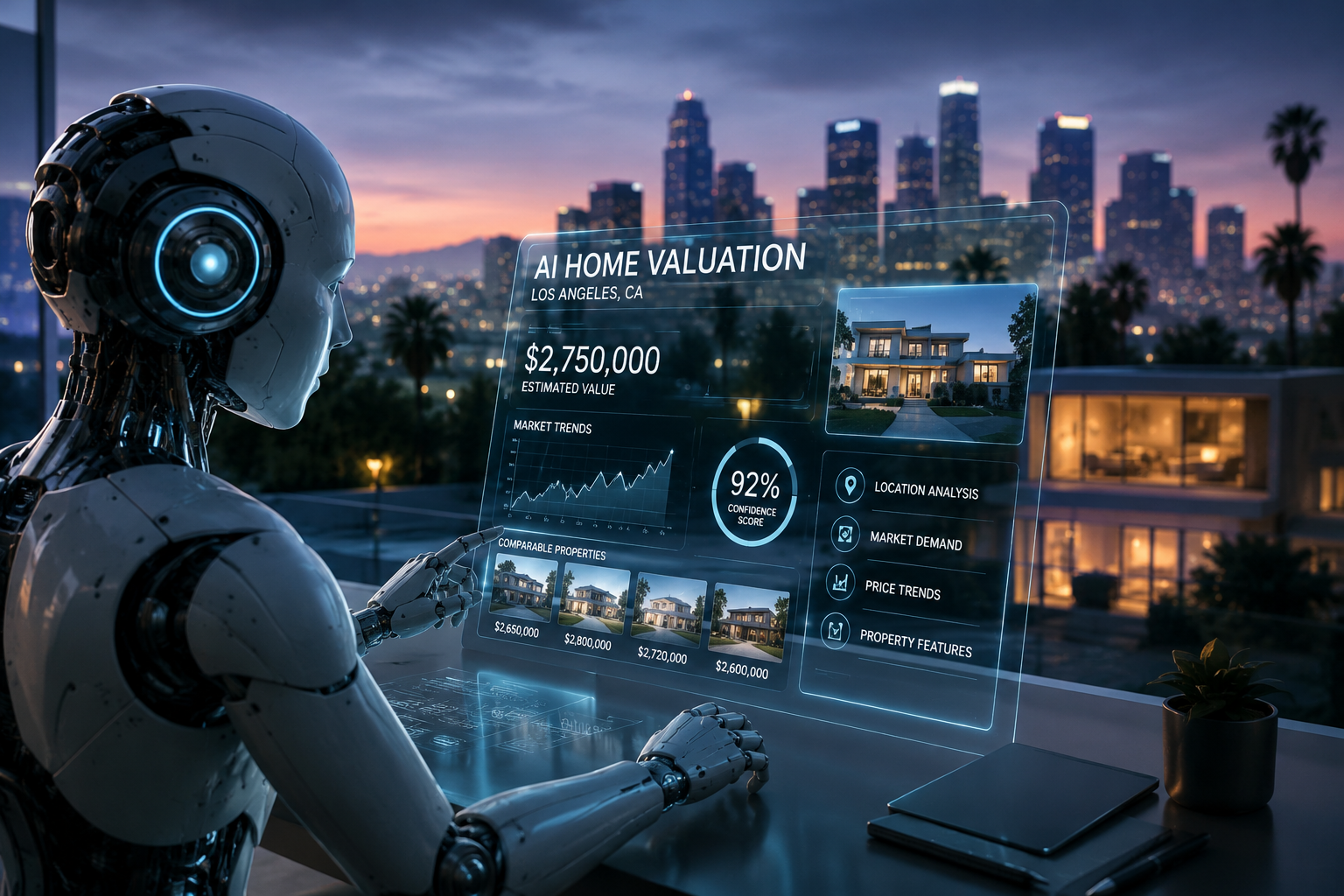
Artificial intelligence can analyze enormous amounts of information in seconds. It can recognize patterns, compare data, summarize market information, and help us make sense of numbers that might otherwise take much longer to review.
So it is understandable that homeowners may wonder: Can AI simply tell me what my home is worth?
The answer is more interesting than a simple yes or no.
AI and automated valuation tools can be incredibly useful when evaluating real estate. They can give homeowners a starting point and help identify patterns in a local market. But pricing a home for sale involves something technology still cannot fully understand from data alone: the individual home, the circumstances surrounding the sale, and the behavior of buyers in that particular market.
Understanding what AI can do, and where human judgment still matters, can help homeowners use these tools more wisely.
What Is an Automated Home Valuation?
Many homeowners have already encountered automated home valuations online, even if they have never thought of them as a form of technology driven analysis.
These estimates typically use information from public records, property characteristics, previous sales, nearby transactions, and other available market data to calculate an estimated value.
More sophisticated systems can process very large amounts of information and identify relationships within that data much faster than a person could manually.
That ability is valuable.
If hundreds of homes have recently sold within a particular area, technology can quickly organize those transactions by characteristics such as location, square footage, bedroom count, lot size, and sale price.
But organizing information and interpreting a particular home are not exactly the same thing.
A Home Is More Than Its Data Points
Two homes can appear remarkably similar on paper and still feel completely different when you walk through the front door.
Imagine two houses located only a few streets apart. They have similar square footage, the same number of bedrooms, comparable lot sizes, and were built around the same time.
An automated model may reasonably view them as close comparisons.
But perhaps one has been beautifully maintained while the other needs substantial updating. One may have exceptional natural light, a peaceful backyard, or a layout that buyers immediately connect with. The other may sit on a noisier street or have a floor plan that feels less functional.
Some of those differences may eventually appear in the data. Others are difficult to quantify.
This is one reason an automated estimate should generally be viewed as information rather than a definitive pricing decision.

AI Is Only as Good as the Information Available to It
AI can analyze information extremely well, but it cannot analyze information it does not have.
Property records may contain outdated square footage. Improvements may not be fully reflected in public data. A remodel may have dramatically changed the way a home presents. Conversely, a property may look similar to another home in a database while being in very different condition.
There is also the question of timing.
Real estate markets are constantly moving. New listings come onto the market. Properties receive offers. Sellers reduce prices. Homes fall out of escrow. Buyer activity can strengthen or weaken.
The most useful pricing analysis therefore requires more than simply knowing what sold months ago. It also helps to understand what buyers are seeing and choosing right now.
Asking Price and Market Value Are Not the Same Thing
One of the easiest mistakes to make when looking at real estate data is treating every number as equally meaningful.
A home’s listing price tells us what the seller is asking.
A closed sale tells us what a buyer actually agreed to pay and what successfully completed the transaction.
An active listing can help us understand the competition a seller may face, but it does not prove that buyers believe the home is worth the asking price.
This distinction matters when using AI or any other data tool.
A system can organize active, pending, and sold properties beautifully, but someone still needs to interpret what those different statuses mean.
Pricing Is Also About Positioning
When preparing a home for sale, the question is not simply, “What number describes this property?”
There is another important question:
“How should this home be positioned in the current market?”
Those are not necessarily the same question.
A seller may want to price aggressively and wait for a particular buyer. Another seller may value a faster sale. In some markets, a pricing strategy may be designed to encourage strong early activity. In others, buyers may be more cautious and have many competing homes to choose from.
The appropriate strategy depends on the property, the market, and the seller’s priorities.
AI can help analyze the information behind that decision. It cannot decide what matters most to an individual homeowner.
Where AI Can Be Extremely Helpful
None of this means homeowners should ignore AI. I believe the opposite is true.
Used thoughtfully, AI can make real estate analysis more efficient and potentially more informative.
It can help organize comparable properties, identify patterns, summarize large amounts of market information, examine pricing trends, and highlight questions worth investigating further.
For a real estate professional, these tools can also reduce time spent on repetitive data organization and create more time for analysis, communication, and service.
The important distinction is between using technology to support judgment and asking technology to replace judgment entirely.
Why a Comparative Market Analysis Still Matters
A Comparative Market Analysis, commonly called a CMA, brings several pieces of the pricing puzzle together.
Comparable sales are important, but a thoughtful CMA can also consider active competition, pending activity when information is available, property condition, location, market timing, and the characteristics that distinguish one home from another.
The numbers provide evidence.
The analysis gives those numbers context.
AI can strengthen that process by helping professionals work with information more efficiently. But the final interpretation still benefits from someone asking questions the computer may not know to ask.
Why did one home sell quickly while another remained on the market?
Was there something unusual about a particular sale?
Does a comparable property really compete with this home from a buyer’s perspective?
Has buyer behavior changed since the older comparable sales closed?
Those questions require context.
The Best Use of AI May Be as a Second Set of Eyes
I do not think homeowners need to choose between technology and people.
The more useful approach may be to combine them.
AI can serve as an extraordinarily capable analytical assistant. It can process information, identify patterns, and help us notice things we might want to examine more closely.
A real estate professional can then evaluate those findings in the context of the actual property, the neighborhood, current competition, and the seller’s goals.
That combination is much more interesting to me than asking whether AI will replace traditional real estate analysis.
The better question is how we can use better technology to make better informed decisions.
What Should Los Angeles Homeowners Take Away From This?
If you look up your home online and see an automated value, you do not need to dismiss it.
But you also do not need to treat it as a final answer.
Think of it as one piece of information.
If you are simply curious about your home’s approximate value, an automated estimate can be a convenient place to begin. If you are actually considering selling, the pricing decision deserves a deeper look at recent comparable sales, current competition, the home’s individual characteristics, and what is happening in your specific local market.
Los Angeles is not one uniform real estate market. Even within the Westside, buyer behavior and property characteristics can vary significantly from neighborhood to neighborhood and sometimes from one street to another.
Technology gives us more information than homeowners and real estate professionals have ever had before.
The opportunity is not to surrender our decisions to that technology.
It is to use it intelligently.
With gratitude and a heart for service,
Claudia Backus, MBA
California Real Estate Broker | REALTOR®
Serving Pacific Palisades & the Westside of Los Angeles