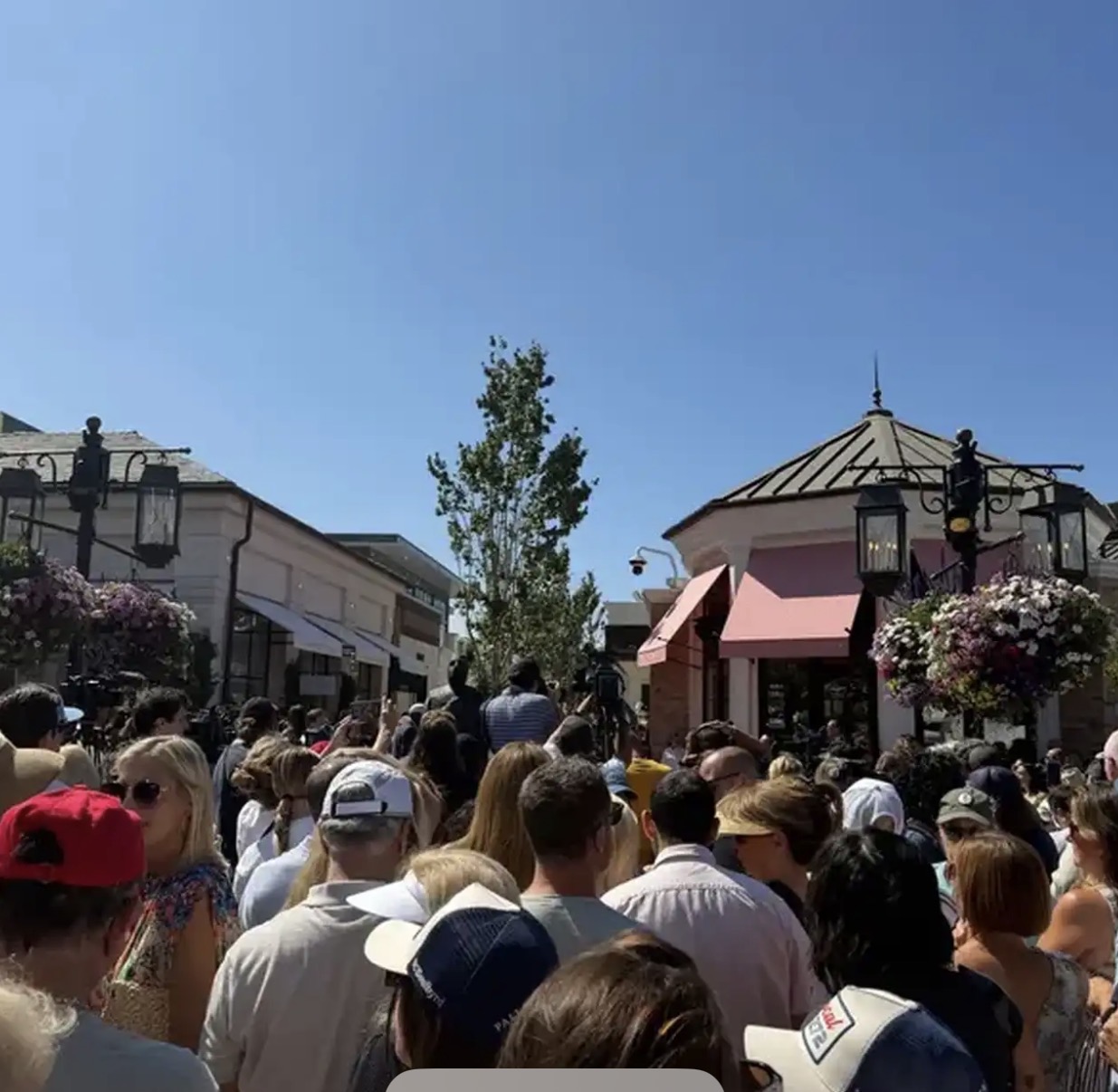
Yesterday, Saturday, August 15, was a very special day in Pacific Palisades. After being closed for more than 19 months following the devastating Palisades Fire, Palisades Village officially reopened.
I went to the reopening with my children, and what struck me most was simply seeing people together again. The Village was crowded, there was a flyover overhead, and everywhere I looked I seemed to recognize a familiar face. After everything our community has experienced since January 2025, there was something incredibly encouraging about seeing people walking through the Village again, talking, laughing and enjoying a place that had been such a familiar part of life in the Palisades.
More Than the Reopening of a Shopping Center
Palisades Village is, of course, a place to shop and eat, but for those of us who live here, it has also been part of the rhythm of the community. It is a place where you run into neighbors, take your children, meet a friend for coffee or simply walk around.
That is why yesterday felt significant. The reopening does not mean that the recovery of Pacific Palisades is complete. It isn’t. There are still homes to rebuild, businesses trying to return, families making difficult decisions and enormous amounts of work ahead of us.
But having an important gathering place in the center of the community reopen feels like another meaningful step forward.
Rick Caruso and the Caruso team made the decision to restore and reopen Palisades Village after the fire, and yesterday it was wonderful to see that work come to life. Seeing the crowds return was also a reminder that people still care deeply about this community and want to be part of its future.
“Broken But Together”
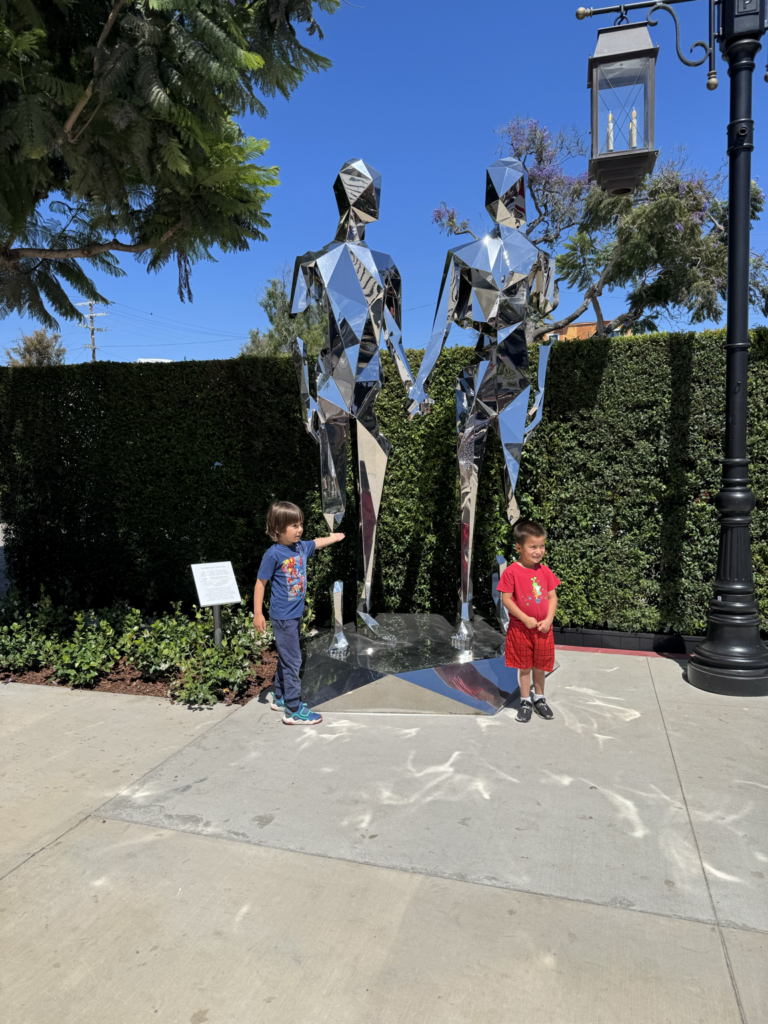
One of my favorite moments yesterday happened when I took this photograph of my sons, Elon and Enzo, next to a sculpture that is now displayed at Palisades Village.
My sons, Elon and Enzo, with Michael Benisty’s “Broken But Together” at Palisades Village. The sculpture survived the Palisades Fire and has found a new home in the Village.
At first, my children were simply fascinated by the two enormous mirrored figures. But after learning the story behind them, the photograph became much more meaningful to me.
The sculpture, called Broken But Together by artist Michael Benisty, survived the Palisades Fire after the property where it had been displayed was destroyed. It was later recovered and has now been given a home at Palisades Village.
I love the meaning behind it because it feels especially appropriate here. Pacific Palisades has been through tremendous loss. Rebuilding does not erase what happened, and reopening one part of our community does not mean everything is suddenly back to normal. But piece by piece, familiar parts of our community are returning and new ones are taking their place.
Yesterday was one of those pieces.
What Does This Mean for Pacific Palisades Real Estate?
As a Pacific Palisades resident and real estate broker, I also found myself thinking about what the reopening means for the future of real estate in our community.
Real estate is about much more than the house itself.
When someone chooses where to live, they are also choosing the community around that house. They care about the places where they can walk, shop, eat, take their children and spend time with friends. They care about neighborhood businesses, schools, parks, streets and the feeling they get when they drive home.
That is why the recovery of places such as Palisades Village matters to Pacific Palisades real estate.
It would be far too simplistic to say that the reopening of the Village automatically means home values will rise. Real estate values are influenced by many factors, and the Palisades is still navigating an unprecedented rebuilding process.
What I do believe is that the return of businesses, gathering places and everyday community life is an encouraging sign for the long term future of Pacific Palisades. A healthy real estate market depends in part on people wanting to live in a community, and yesterday was a powerful reminder of how many people still believe in this one.
A flyover above Pacific Palisades during the Palisades Village reopening celebration on August 15, 2026.
Looking Ahead at Pacific Palisades
There will be many more milestones ahead.
Some will be large and highly visible, like the reopening of Palisades Village. Others will happen quietly, one property at a time, when a family receives a permit, construction begins on a home, a business reopens or someone finally gets to return.
For homeowners considering whether to rebuild, sell or stay in Pacific Palisades, there are still complicated questions ahead. The answers will be different for every family. I think it is important to be realistic about that while also recognizing the progress happening around us.
Yesterday, I saw a lot of that progress in one place.
I saw familiar faces. I saw neighbors gathering again. I watched my boys explore a place that will become part of their own memories of growing up in Pacific Palisades. And standing there with my kids next to Broken But Together, I was reminded that rebuilding a community is not something that happens all at once.
It happens piece by piece.
I am grateful to everyone who has worked to bring this part of our community back, and I am hopeful about what comes next for Pacific Palisades.
With gratitude and a heart of service,
Claudia Backus, MBA California Real Estate Broker | REALTOR® Serving Pacific Palisades & the Westside
One of the most common questions in real estate is also one of the hardest to answer:
“How is the market?”
It sounds like a simple question. But after attending The MLS Summit 2026 at the Skirball Cultural Center in Los Angeles, one idea stayed with me: before answering that question, we should first ask, which market?
That may seem like a small distinction, but for a homeowner thinking about selling, it can make a very big difference.
There is no single Los Angeles real estate market behaving exactly the same way everywhere. The market for a home in Pacific Palisades may look very different from the market for a condominium in West Los Angeles. Even within the same neighborhood, homes in different price ranges, locations, sizes, and conditions may face very different competition. That is why I believe homeowners deserve something more useful than a general statement that “the market is good” or “the market is slow.”
Your Home Has Its Own Market
When we hear reports about the Los Angeles housing market, we are usually looking at broad statistics. Those numbers can certainly be useful. They help us understand larger trends in prices, inventory, interest rates, and buyer activity.
But when someone is preparing to sell a particular home, the question becomes much more specific.
What are buyers looking at as alternatives to this home right now? How many similar properties are currently available? What price range are they in? How long have they been on the market? What condition are they in? And perhaps most importantly, how does this particular property fit within those choices? That smaller universe is the market that matters most to the homeowner.
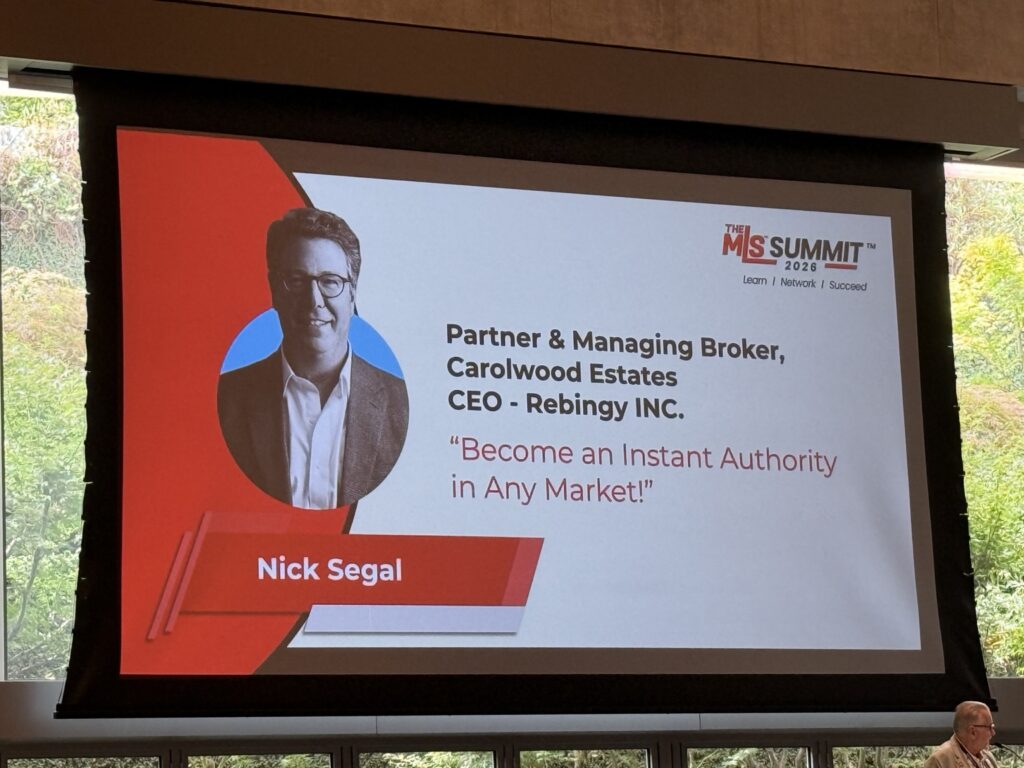
Nick Segal presenting “Become an Instant Authority in Any Market!” at The MLS Summit 2026. One takeaway that stayed with me was the importance of defining which market we are actually talking about before discussing real estate conditions.
Why Active Listings Matter When Selling a Home
Something else I brought home from the Summit was a greater appreciation for active inventory.
When homeowners think about the value of their property, it is natural to focus on homes that recently sold. Those sales are extremely important, and they are a major part of a thoughtful comparative market analysis.
But active listings tell us something different.
They show us the competition a seller may be facing today.
Imagine that a buyer is searching for a home within a particular area and price range. That buyer may have several properties to choose from this weekend. Those homes are competing for the buyer’s attention at the same moment. Looking carefully at that active competition can help a seller better understand how buyers may perceive the home’s price, condition, location, features, and overall value.
The Market Can Change Within a Few Blocks
This is especially interesting to me as someone who lives and works on the Westside of Los Angeles.
We often talk about areas such as Pacific Palisades, Brentwood, Santa Monica, Westwood, and the surrounding Westside as though each one represents a single market. In reality, even within those communities there can be smaller markets.
Price range matters. Property type matters. Location within a neighborhood matters. Condition matters. Views, lot size, privacy, layout, renovations, and proximity to certain amenities can matter too.
And then there is timing. The competition a homeowner faces when listing a property today may not be the same competition that existed three months ago or will exist three months from now.
Real estate conditions can vary significantly by neighborhood, property type, price range, and even the competition available to buyers at a particular moment.
Online Estimates Cannot See Everything
Technology has given homeowners access to an incredible amount of real estate information. I think that is a good thing.
A homeowner can look up estimated values, recent sales, neighborhood statistics, and properties for sale in a matter of minutes. Artificial intelligence is making access to information even faster.
But information and interpretation are not quite the same thing.
An automated system may know the square footage and number of bedrooms. It may identify nearby sales. What it may not fully understand is why one comparable is more meaningful than another, how buyers are responding to the current competition, or whether something unique about a home’s condition, location, layout, privacy, view, or improvements changes the comparison. This is one of the reasons I continue to believe that technology and professional judgment work best together.
Good Real Estate Advice Starts With Homework
I have written before that I think of preparing a CMA as doing homework, and I really mean that.
The more I learn about the MLS and the information available to real estate professionals, the more I appreciate how much there is to study before giving a homeowner an opinion about their property.
For me, being prepared means looking beyond one number. It means studying relevant sales, examining active competition, understanding the specific micro market, considering the characteristics of the property, and then explaining what the information may mean for the homeowner’s selling strategy. I would much rather tell someone, “Let me study your particular market,” than give them a quick answer based on a headline about Los Angeles real estate.
So, How Is the Market?
The next time someone asks me that question, I may answer with another one:
Which market?
Because if you are thinking about selling your home, the market that matters most is not necessarily the one being discussed on television or summarized in a national headline.
It is the market surrounding your home, your competition, your price range, and your goals.
One of the reasons I enjoy continuing to learn about real estate and the MLS is that better information helps me be of better service. Homeowners make important financial and personal decisions when they sell a home, and I believe they deserve advice based on preparation, context, and careful attention to the market that actually matters to them.
Claudia Backus, MBA California Real Estate Broker | REALTOR® Serving Pacific Palisades & the Westside
If you are thinking about selling your home, you have probably asked some version of the question, “What is my house worth?” Today, homeowners can find estimates online in seconds, but understanding how a home fits into the current market usually requires more than one automated number.
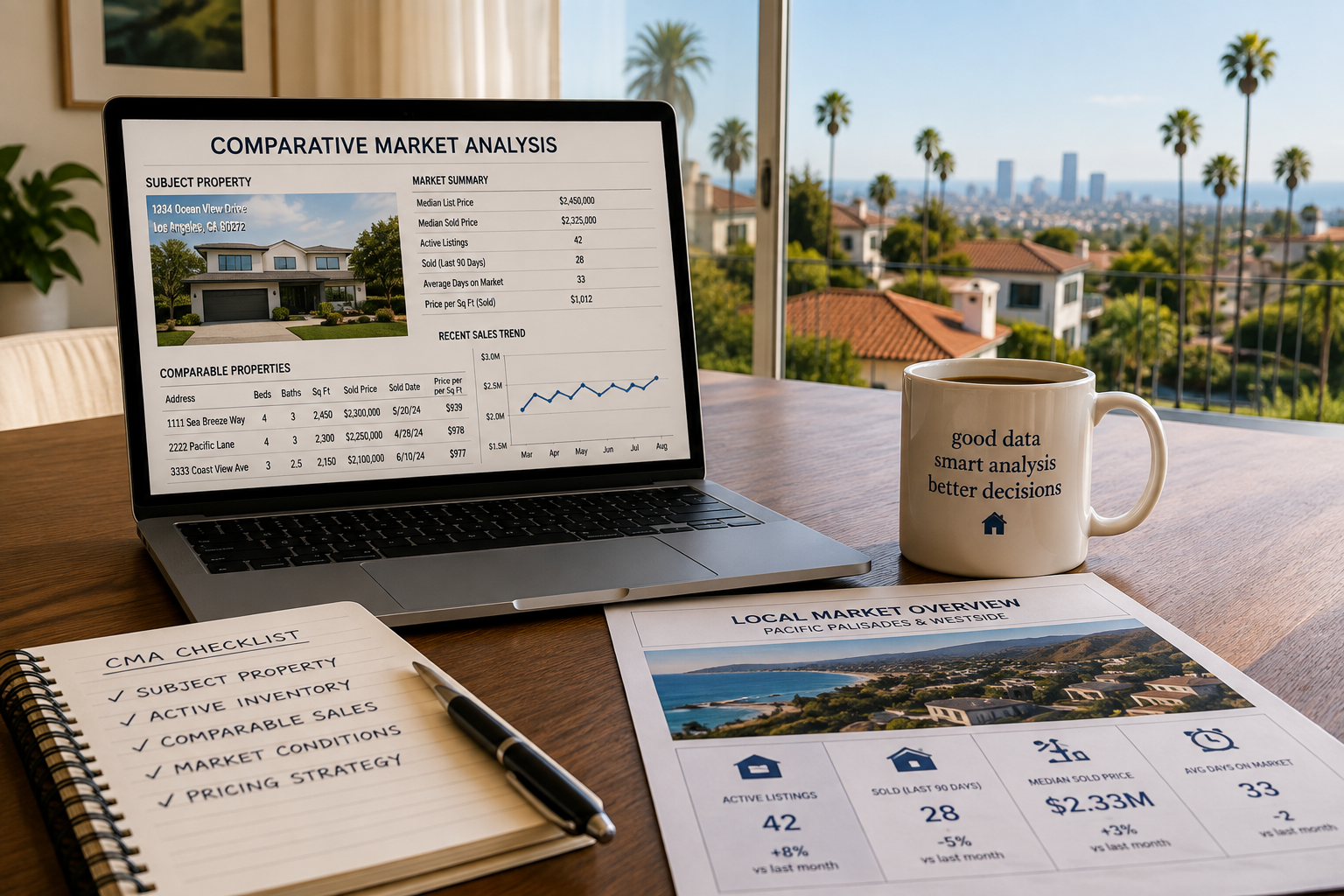
A Comparative Market Analysis, commonly called a CMA, is one of the tools real estate professionals use to help answer that question. A thoughtful CMA looks at relevant properties, current market conditions, active competition, and the characteristics of a specific home to help a homeowner understand a reasonable pricing range and begin thinking about a selling strategy.
As a mom of three young children, the word “homework” has taken on a whole new meaning in my life. But there is another kind of homework I have come to appreciate in real estate: the work that should happen before advising someone about the value and pricing of their home. To me, a good CMA is exactly that kind of homework.
What Is a CMA in Real Estate?
A CMA is an analysis of comparable properties and market conditions used to help estimate how a home may compete in the current real estate market. It usually includes recent sales, but a good analysis goes beyond finding a few homes nearby and averaging their sale prices.
The goal is to identify properties that are meaningfully comparable and then understand the differences. Location, size, condition, renovations, lot characteristics, views, layout, privacy, and other property specific details can all affect how buyers perceive value. Two homes can be close to one another and still compete very differently in the market. This is one reason I believe a CMA should be researched rather than simply generated. The data matters, but so does deciding which data is actually relevant.
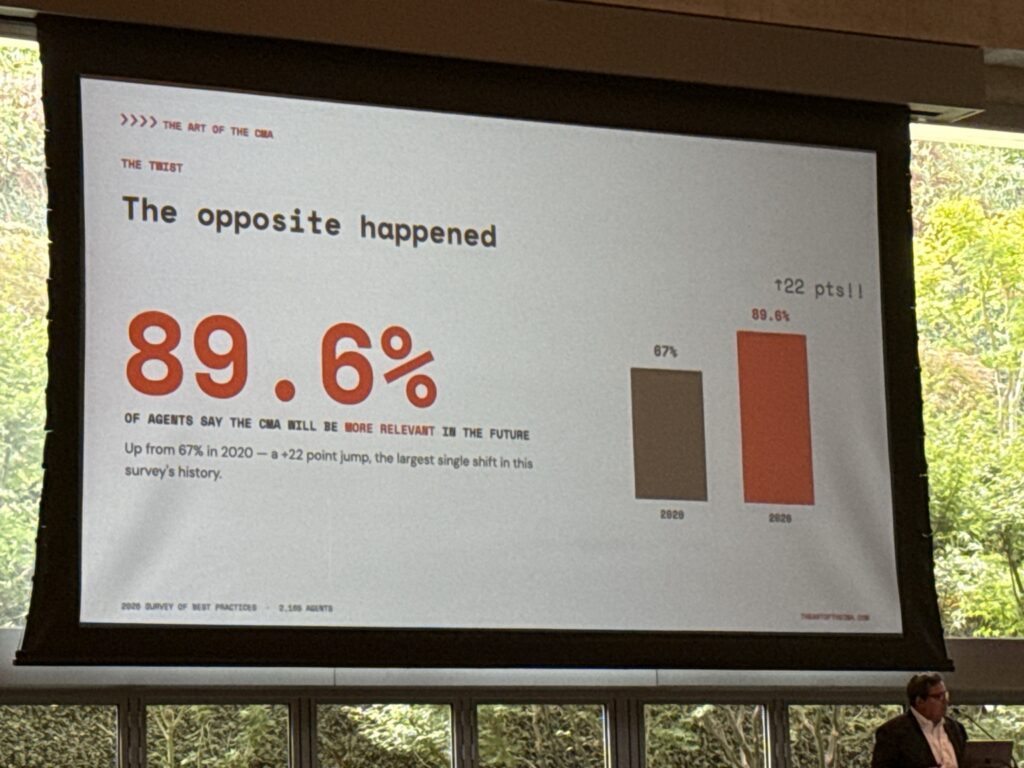
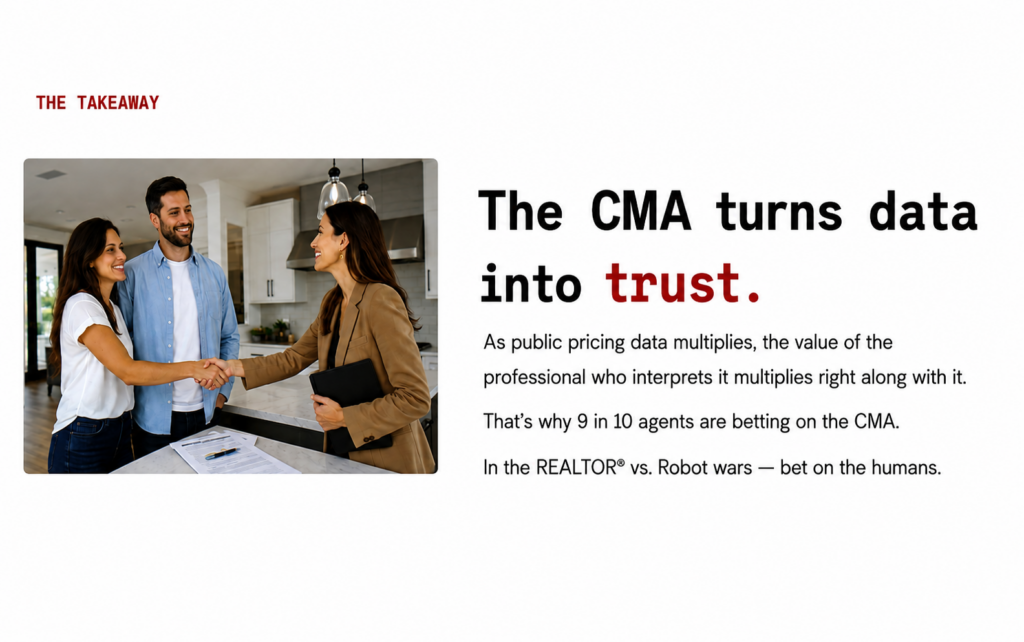
One statistic that caught my attention at The MLS Summit 2026 was how strongly real estate professionals continue to value the CMA, even as consumers have access to more online home valuation tools.
Why Does a CMA Still Matter When We Have Online Home Estimates?
Homeowners now have access to more real estate information than ever before, and I think that is a good thing. Online valuation tools can be useful as a starting point, and artificial intelligence is creating even more ways to organize and analyze information. I use technology myself and enjoy learning how these tools can help us work more intelligently.
But an estimate and an analysis are not quite the same thing. An automated tool may not fully understand a remodeled kitchen, an unusual floor plan, the quality of a view, the condition of a property, or why buyers may respond differently to two homes that look similar on paper. A CMA gives us an opportunity to look at the data in the context of the actual property and the market around it.
That distinction became even clearer to me at The MLS Summit 2026. As public real estate data and AI tools continue to grow, I do not think the professional role becomes less important. I think the responsibility shifts toward understanding the information, verifying it, interpreting it carefully, and explaining it clearly to the homeowner.
A CMA Is More Than Looking at Sold Homes
One of my favorite practical takeaways from the Summit was the importance of looking closely at active inventory. Sold properties tell us what buyers were willing to pay in the recent past, which is important, but active listings tell us what a buyer can choose today.
If you are preparing to sell, your home is not only being compared with properties that sold three months ago. It will compete with the homes buyers can tour and consider right now. Understanding that active competition can help put pricing, condition, presentation, and strategy into perspective.
This is also where the idea of a micro market matters. Asking “How is the Los Angeles market?” is often too broad to be very useful for one homeowner. The more helpful question is: what is happening in the particular market in which this particular home will compete? Price range, neighborhood, property type, size, condition, and buyer expectations can create very different markets within the same city.
A Home Is Not Just a Collection of Data
A CMA depends on data, but a home is not simply a collection of numbers. This is where professional judgment and local context become important. How does the home compare with the competition buyers are seeing right now? Which comparable properties are truly comparable? Does a renovation add the value a homeowner expects it to add? How might buyers respond to the condition, layout, lot, view, privacy, or location?
Those questions do not mean the data is less important. They mean the data needs to be interpreted. A good CMA should help a homeowner understand not only what the numbers say, but why certain properties are more relevant than others and what those comparisons may mean for the home’s position in the market.
Pricing Can Be Personal
Pricing a home is both analytical and personal. For many homeowners, a house represents far more than an investment. It may be where children grew up, where holidays were celebrated, where years of improvements were made, or simply a place filled with memories. It makes sense that conversations about value can carry emotion.
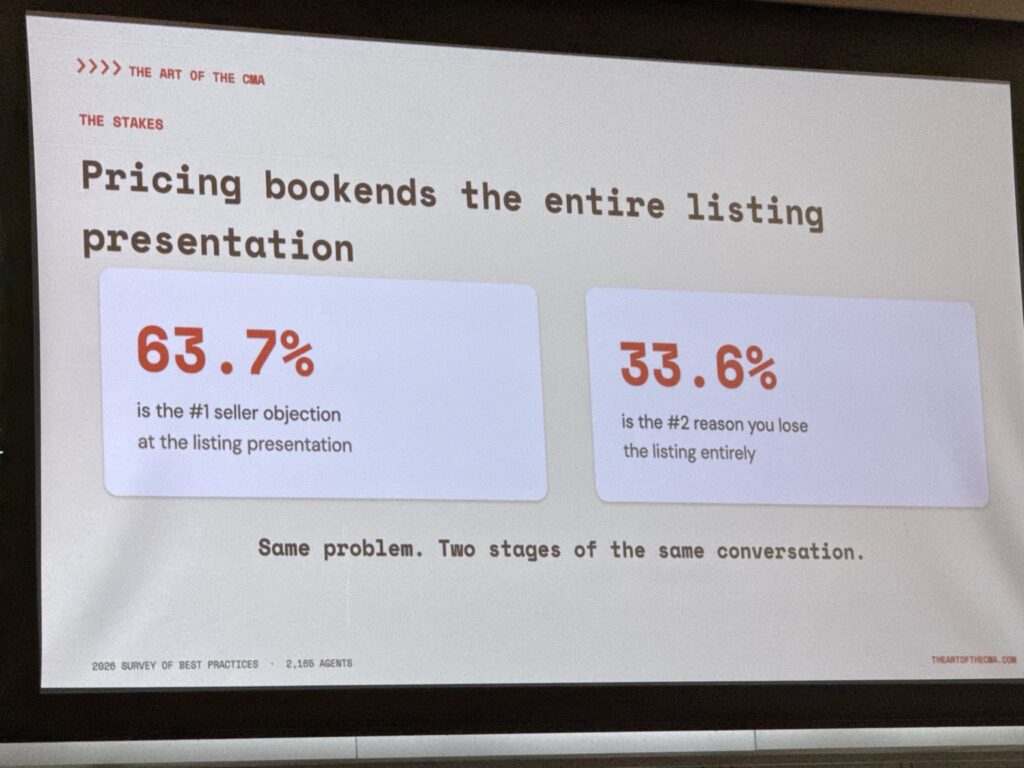
Pricing was a major theme during the CMA discussion at The MLS Summit 2026. The presentation shared survey data showing that pricing was the number one seller objection at a listing presentation, reported by 63.7 percent of surveyed agents. I do not interpret that statistic as homeowners being difficult. I see it as a reminder of how important it is for a real estate professional to arrive prepared and be able to explain the evidence behind a pricing recommendation.
Pricing was an important part of the CMA discussion at The MLS Summit 2026. A thoughtful CMA can give homeowners an evidence based starting point for understanding how their home fits into the current market.
A CMA Is a Starting Point for a Conversation
I do not think the purpose of a CMA is to walk into someone’s home, announce a number, and end the conversation. The more useful approach is to walk through the information together. Which properties were selected as comparables? Why were they selected? What is currently competing for buyers’ attention? Where is the subject property stronger or weaker? What has changed in the market?
The homeowner’s goals matter too. One seller may prioritize achieving the highest possible price and have flexibility with timing. Another may need to move within a certain period. Someone else may value privacy, simplicity, or certainty. The market data helps inform the strategy, but the strategy should also reflect the person making the decision.
That is why I like thinking of a CMA as the beginning of a thoughtful pricing conversation rather than a final verdict on what a home is worth.
Doing the Homework Before Selling
The more I learn about real estate, the more I appreciate how much responsibility comes with giving someone guidance about their home. A CMA may begin with numbers, but its purpose is not simply to produce a number. It is to help a homeowner understand the market, ask better questions, and make a decision with more information and confidence.
To me, that is what doing the homework is really about. If someone trusts me enough to ask for guidance about one of their largest assets, I want to come prepared, keep learning, explain what I see as clearly as I can, and do my best to be of service.
Claudia Backus, MBA, REALTOR® California Real Estate Broker Serving Pacific Palisades & the Westside
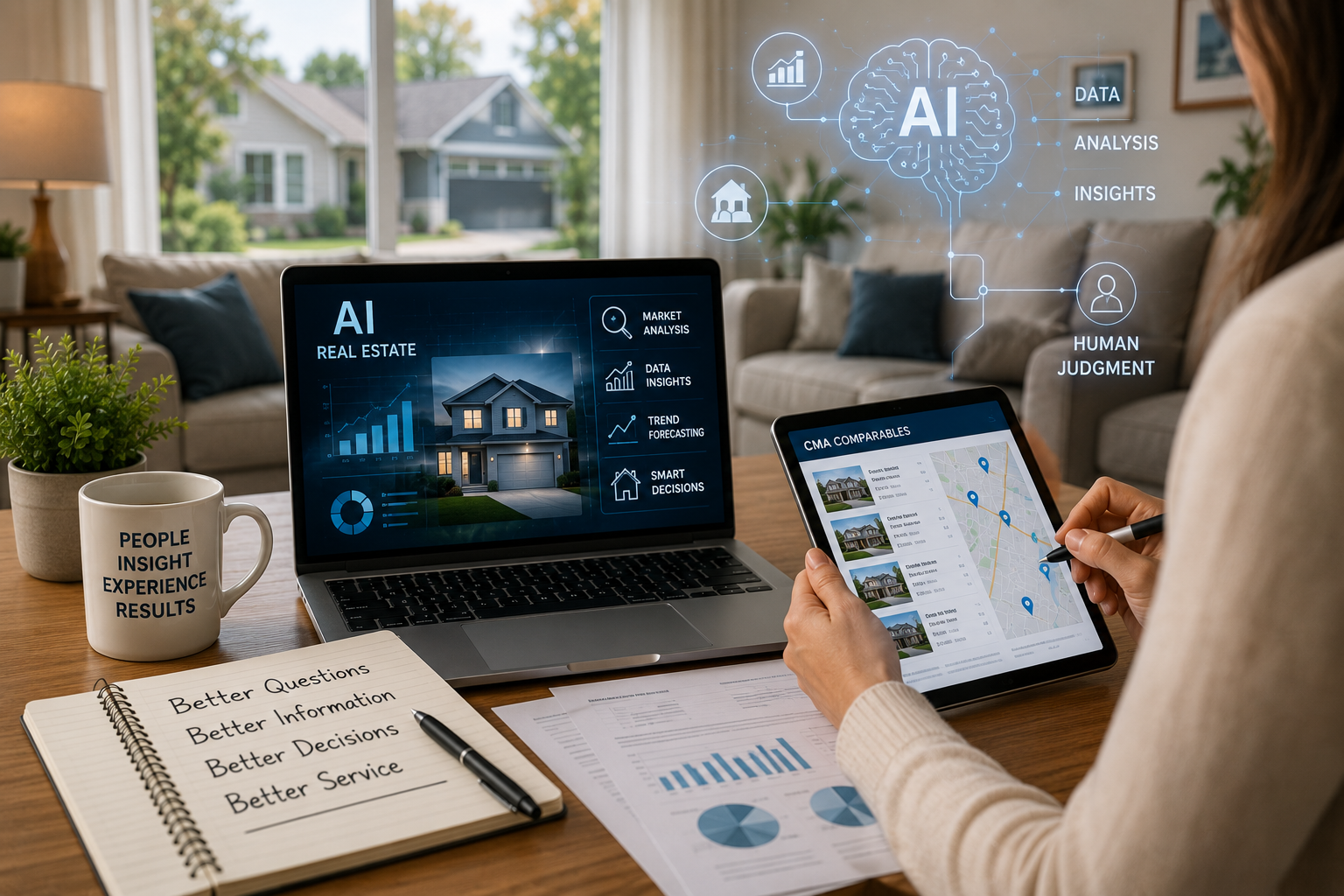
This week, while attending The MLS Summit 2026 at the Skirball Cultural Center on the Westside of Los Angeles, I was especially interested in the conversations about artificial intelligence and the ways AI is becoming part of the real estate industry. I love AI. I use it, I learn from it, and I am fascinated by how quickly the technology is developing. At the same time, I believe that the more powerful these tools become, the more important it is to understand what they can do well, where they can be wrong, and when human judgment still matters.
For homeowners thinking about selling, I believe that distinction is particularly important. Technology can help us work faster and analyze more information, but selling a home is still a very personal decision that involves goals, timing, finances, circumstances, and sometimes a great deal of emotion.
My Interest in AI Started Before the MLS Summit
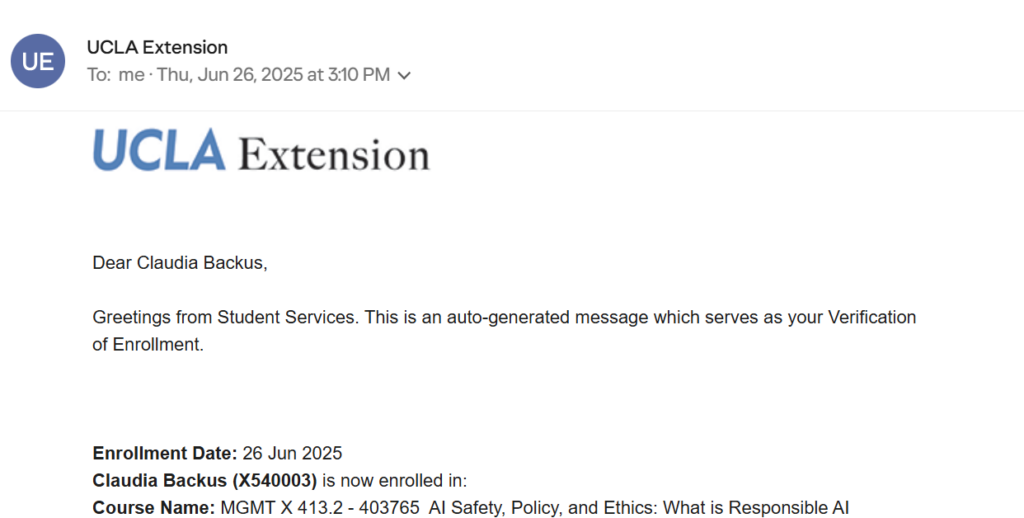
My interest in artificial intelligence did not begin at this conference. Last summer, I took a UCLA Extension course called AI Safety, Policy, and Ethics: What is Responsible AI. I wanted to understand not only what artificial intelligence can do, but also how it should be used responsibly, including questions involving ethics, safety, transparency, accountability, and privacy.
Even after completing my formal education, I have always enjoyed taking classes and continuing to learn. Real estate, technology, finance, and business are constantly changing, and I do not think learning should stop simply because you have a degree or a professional license.
Even after graduation, I have always enjoyed continuing to learn. Last summer, that curiosity led me to take AI Safety, Policy, and Ethics: What is Responsible AI through UCLA Extension.
AI Has Already Changed the Way I Learn Real Estate
One reason I personally appreciate AI is that it helps me ask better questions. Real estate has an enormous amount to learn, from MLS rules and contracts to disclosures, market statistics, pricing considerations, financing, local regulations, and technology. When I encounter something unfamiliar, AI can help me understand terminology, organize a complicated subject, think through questions I may not have considered, and identify what I need to research further.
I find that incredibly useful, but there is an important distinction between using AI to help formulate a question and assuming that its answer is correct. I still need to verify important information through the appropriate sources, review MLS data, understand the property and local market, and sometimes ask another professional who knows considerably more about a particular subject than I do. AI can help me learn, but it does not eliminate my responsibility to do my homework.
There Is More Than One AI Tool
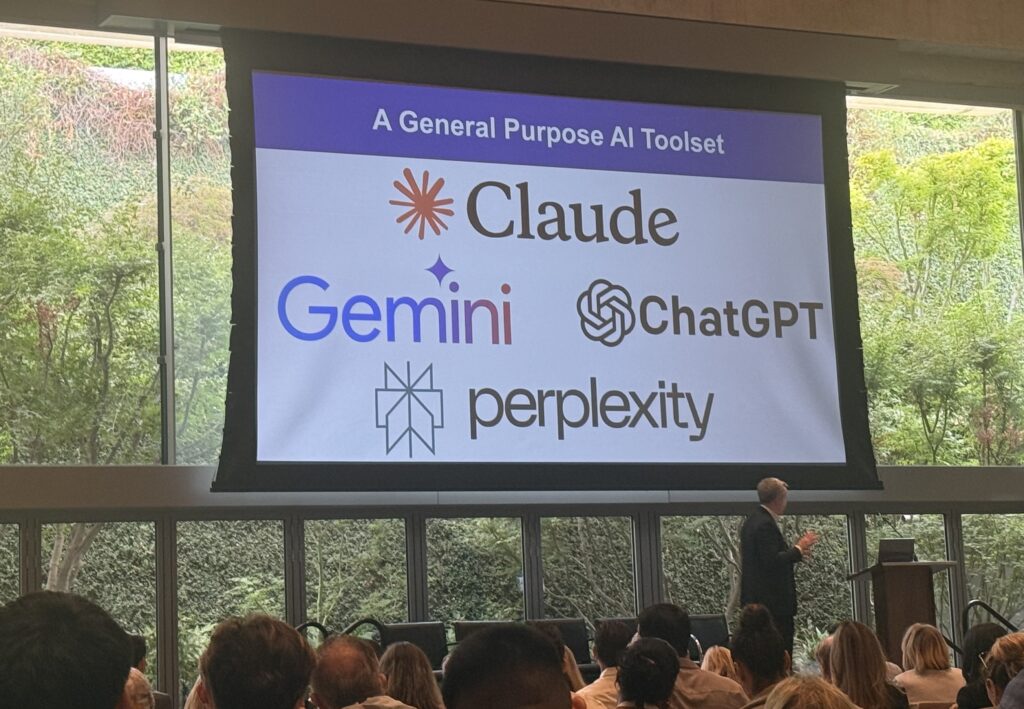
One of the slides at The MLS Summit showed several general purpose AI tools together, including ChatGPT, Claude, Gemini, and Perplexity. I liked that slide because it was a reminder that AI is no longer one mysterious piece of technology. Professionals now have access to different tools that can assist with research, organization, analysis, communication, and productivity.
Artificial intelligence was part of the conversation at The MLS Summit 2026, including how tools such as ChatGPT, Claude, Gemini, and Perplexity are becoming part of everyday professional workflows.
For real estate professionals, these tools can potentially help us organize information, analyze data, prepare for conversations, research unfamiliar topics, and work more efficiently. That can be valuable, but efficiency is not the same thing as judgment.
A Home Is Not Just a Collection of Data
This is where I think the conversation becomes especially relevant for home sellers. AI can analyze numbers very quickly, recognize patterns, and process amounts of information that would take a person considerably longer to review. That ability can be extremely helpful when we are studying a market or trying to make sense of a large amount of real estate data.
But determining how to position a particular home for sale requires context too. How does the home compare with the competition buyers are seeing right now? Which comparable properties are truly comparable? Does a renovation add the value a homeowner expects it to add? How might buyers respond to the condition of the property? Is there something unusual about the location, lot, layout, view, privacy, or neighborhood that changes the comparison? These are the kinds of questions where data is important, but interpreting the data matters just as much.
There is also something even more important that a computer cannot decide for a homeowner: what the seller actually wants. One person may prioritize price, while another may care more about timing, privacy, convenience, or certainty. A family may also have circumstances that influence which selling strategy makes the most sense. Understanding those priorities requires a conversation, not simply an algorithm.
AI Can Provide Information, but People Provide Context
I do not see AI and real estate professionals as competitors. I think the better question is whether a real estate professional knows how to use technology without outsourcing judgment to it. If AI can help me research something faster, discover a question I should be asking, or organize information so I can spend more time understanding a seller’s goals, I consider that valuable.
At the same time, I never want technology to become a substitute for listening. For me, good real estate service still means understanding the person sitting across from me, doing the research, verifying important information, explaining the available choices, and being willing to say, “I need to look into that further,” when I do not know an answer. In many ways, I think AI makes that responsibility more important, not less.
The Future of Real Estate Can Be Both High Tech and Human
I am excited about artificial intelligence, and I want to keep learning about it, experimenting with it, and finding responsible ways to use it in my work. At the same time, I hope the real estate industry never loses sight of what technology is supposed to accomplish. It should help us become better informed, ask better questions, work more efficiently, and ideally give us more time and better information to serve people well.
Homes are personal. Selling one can involve finances, family, memories, uncertainty, and major life decisions. No matter how sophisticated our technology becomes, I believe there will always be value in having a knowledgeable human being listen, think, research, explain, and care.
I am grateful that I have opportunities to keep learning, whether through a UCLA Extension classroom, a real estate conference, the MLS, or simply asking another question when I realize there is something I do not yet understand. For me, that is what learning is ultimately for: not simply knowing more, but becoming better equipped to be of service to others.
Claudia Backus, MBA, REALTOR® California Real Estate Broker Serving Pacific Palisades & the Westside
This week, I attended The MLS Summit 2026 at the Skirball Cultural Center on the Westside of Los Angeles. I went ready to learn, and I left with an even greater appreciation for how much information is available through the MLS and how important it is for real estate professionals to know how to use that information well.
As a real estate broker, I believe knowledge is part of service. The more I understand about the market, the tools available to me, and the choices available to sellers, the better prepared I am to help someone make a thoughtful decision about one of their largest assets. One of my biggest takeaways from the day was simple: the MLS is much more than a place where homes are listed for sale.
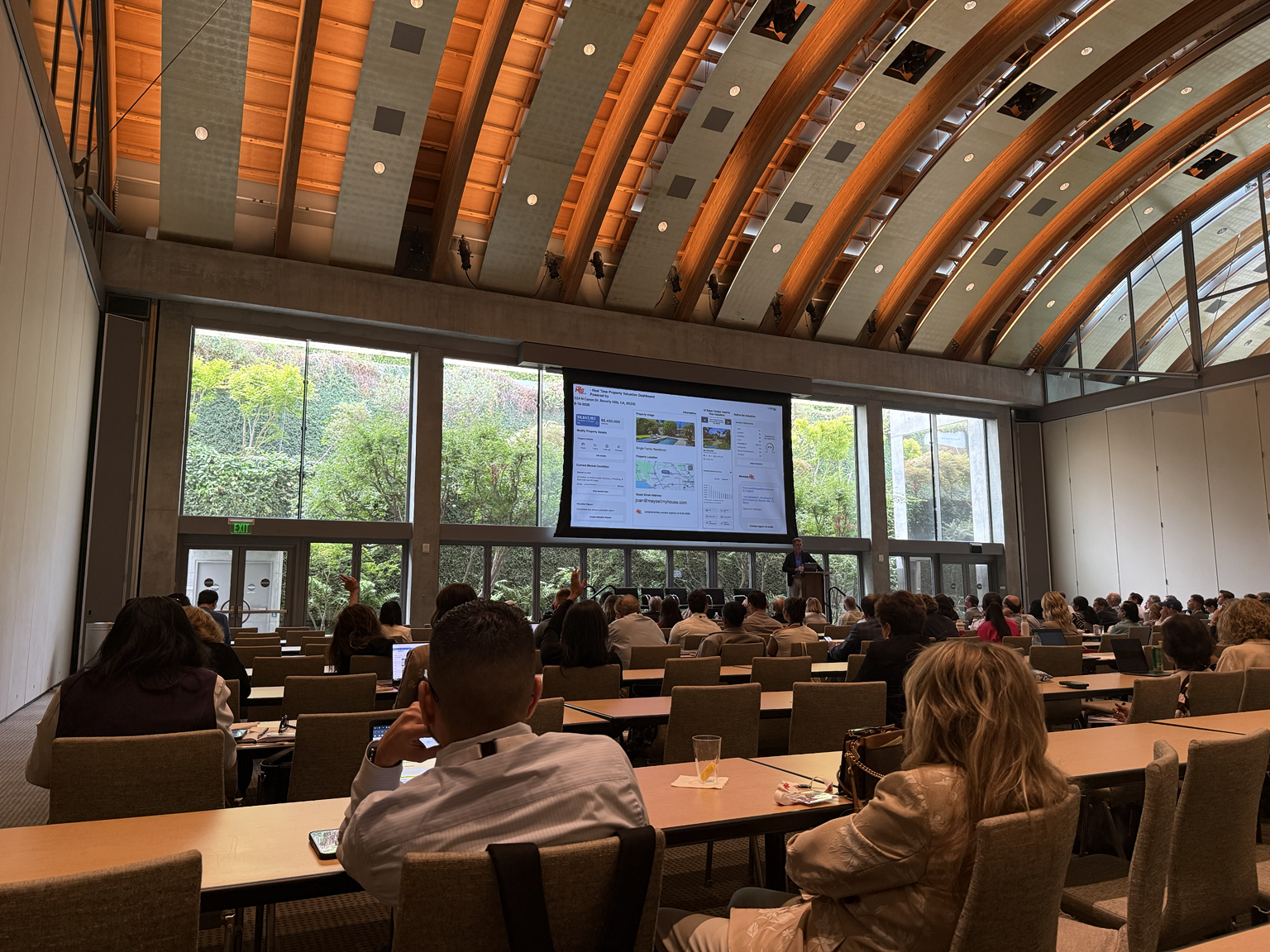
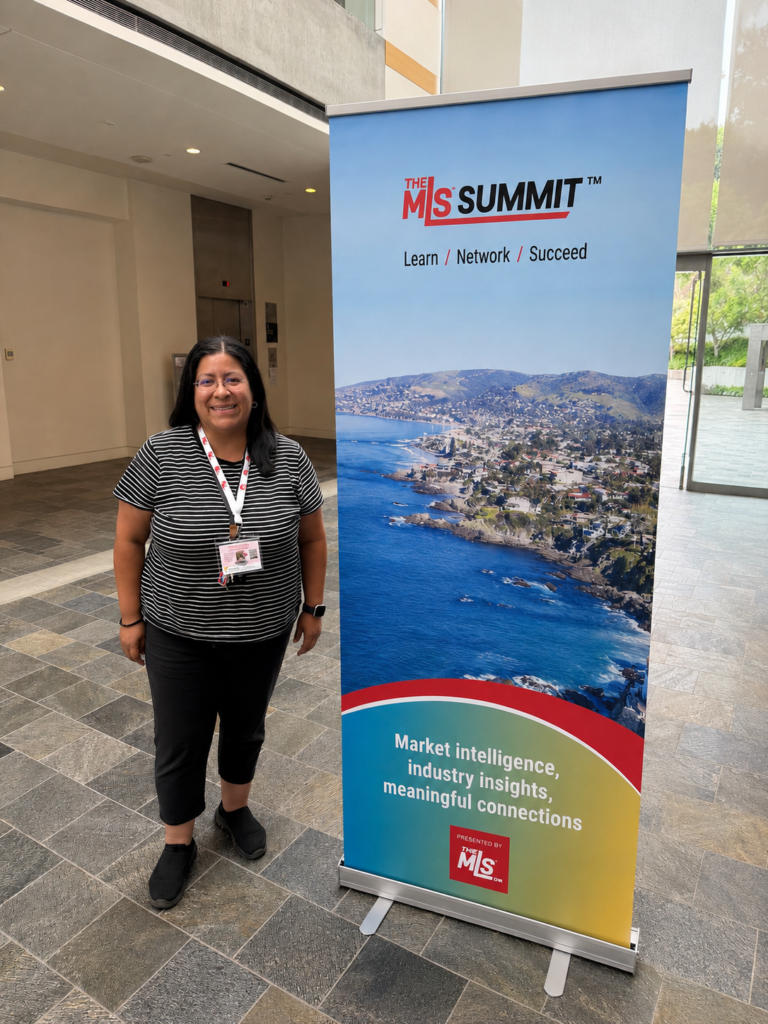
A fun day of learning at The MLS Summit 2026. There is always more to learn in real estate, and I believe that knowledge helps me better serve my clients.
So, Why Does the MLS Still Matter to Home Sellers?
Today, homeowners have access to an incredible amount of real estate information online. You can search for homes, look at estimated values, review recent sales, and follow the market from your phone. That access is useful, but having information and knowing how to interpret it are not always the same thing.
For a homeowner preparing to sell, the questions become much more specific. Which recently sold homes are actually comparable to yours? What homes are currently competing for the same buyers? How long are similar properties taking to sell? Have there been price reductions? What happened with listings that did not sell? And what does all of that information mean for your particular home?
This is where professional MLS access, combined with research, local knowledge, and human judgment, can become very valuable. The MLS gives real estate professionals detailed information that can help us understand not only what has sold, but also what is happening in the market right now.
A CMA Is More Than a Number
One of the sessions that especially resonated with me was about the Comparative Market Analysis, or CMA. To me, a good CMA is homework. It means studying the property, looking carefully at relevant comparable sales, understanding the current competition, considering the differences between properties, and paying attention to what is happening in that particular market.
That matters because pricing a home is not simply about finding a number that sounds good. A thoughtful pricing strategy should have a reason behind it, and a seller should be able to understand that reason. Data is important, but so is the ability to interpret it and explain what it may mean for a specific property.
Technology Can Help, but Judgment Still Matters
I love AI, and I believe technology will continue changing real estate in ways we are only beginning to understand. AI can help professionals research, organize information, identify patterns, and work more efficiently. I am excited to keep learning how to use these tools responsibly and effectively.
At the same time, the summit reinforced something important for me. More technology does not make good real estate information less important. It makes knowing what information to trust and how to use it even more important. A seller does not need someone simply because that person can pull up data. A seller needs someone who can study the information, ask good questions, explain what matters, and apply it to the seller’s actual situation.
AI was part of the conversation at The MLS Summit 2026, and I believe these tools can help real estate professionals work more efficiently while still relying on human judgment and trusted market information.
Sellers Should Understand Their Options
Another reason the MLS continues to matter is exposure and choice. Not every seller has exactly the same priorities. One homeowner may want broad exposure. Another may care deeply about privacy. Someone else may be focused on timing, convenience, cost, or having more control over the selling process.
My philosophy is not that every homeowner needs exactly the same service. I believe in being a broker who gives sellers options, explains those options clearly, and helps them understand the advantages and limitations of each one. The right approach should be based on the seller’s goals, the property, the market, and the rules that apply.
My job is not to push someone toward the option that benefits me most. My job is to help a seller understand the choices, provide useful information, and support that seller in making a decision that makes sense for them.
Knowledge Is Part of Service
I left The MLS Summit 2026 reminded of how much there is to learn about the MLS and how valuable that learning can be. Real estate changes, technology changes, MLS tools and rules evolve, and markets change. I want to keep learning because every new piece of knowledge gives me another opportunity to become more useful to the people I serve.
For me, being a good broker is not about pretending to know everything. It is about doing the homework, asking questions, continuing to learn, and taking the time to explain things clearly. If you are thinking about selling a home in Pacific Palisades or elsewhere on the Westside of Los Angeles, you deserve to understand the market, the information behind the recommendations you receive, and the choices available to you.
I am grateful for opportunities like The MLS Summit that allow me to learn from others, strengthen my knowledge, and bring that knowledge back to the people I serve. At the end of the day, real estate is about more than properties and numbers. It is about people, trust, and being of service to others. I hope to keep learning with gratitude, keep showing up with a heart for service, and use what I learn to help others make informed decisions with greater confidence.
Claudia Backus, MBA, REALTOR® California Real Estate Broker Serving Pacific Palisades & the Westside
When people think about Santa Monica, California, they may picture the beach, the pier, beautiful neighborhoods, the Third Street Promenade, or simply the experience of living close to the ocean on the Westside of Los Angeles.
When I think about Santa Monica, I think about all of those things – but I also think about community, education, motherhood, service, and many different chapters of my own life.
My connection to Santa Monica began long before I became a local real estate broker serving Pacific Palisades and neighborhoods throughout the Westside of Los Angeles, such as Santa Monica.
From Santa Monica College to UCSB
One of my earliest chapters here was as a student at Santa Monica College before transferring to the University of California, Santa Barbara, where I earned my B.A. in Business Economics.
I have wonderful memories of SMC. The counselors helped me tremendously as I was figuring out my educational and career path, and their guidance made a lasting impression on me.
I also received scholarships from local Kiwanis and Rotary organizations and started a student organization called the Access to Marketing Club. I loved it. Looking back, it probably shouldn’t surprise me that I eventually earned my MBA while working full time. I have always been fascinated by business, marketing, and finding creative ways to connect people with opportunities.
Santa Monica College continues to have an extraordinary transfer tradition, and I remain grateful that part of my own educational journey began there.
Watching Santa Monica Change
Years later, I worked in an office in Santa Monica. One of the perks was being able to walk during my lunch break, browse the shops and grab something to eat nearby.
I remember Johnny Rockets and the familiar stores and restaurants that made those little lunch breaks fun.
Santa Monica has changed since then.
Some longtime businesses have disappeared. New ones have arrived. Downtown Santa Monica and the Third Street Promenade have gone through difficult periods, and concerns about homelessness, public safety, affordability, vacancies and the changing character of the city shouldn’t simply be brushed aside.
I don’t believe loving a community requires pretending that everything about it is perfect.
In fact, I think caring about a community means being willing to recognize both what makes it special and what needs attention.
And there are encouraging signs, too. Santa Monica continues to evolve, welcome new businesses and work through some of its most difficult challenges. Cities change. Neighborhoods change. Real estate changes. The important question is what we do with that change and how we continue building communities where people want to live, work and raise their families.
Santa Monica as a Mom
My relationship with Santa Monica took on another meaning after I became a mother.
I love the Santa Monica Family YMCA, and especially the Zumba classes. There is something wonderful about having community spaces where families can exercise, meet people and simply be part of something local.
Another important part of my Santa Monica story has been Vintage Church Los Angeles. I began attending about a year before the 2025 Palisades fire, initially drawn in part by a group for mothers of young children. I love being around other moms. There is something comforting and often funny about sharing what is working, what definitely isn’t working, and realizing that none of us has parenting completely figured out.
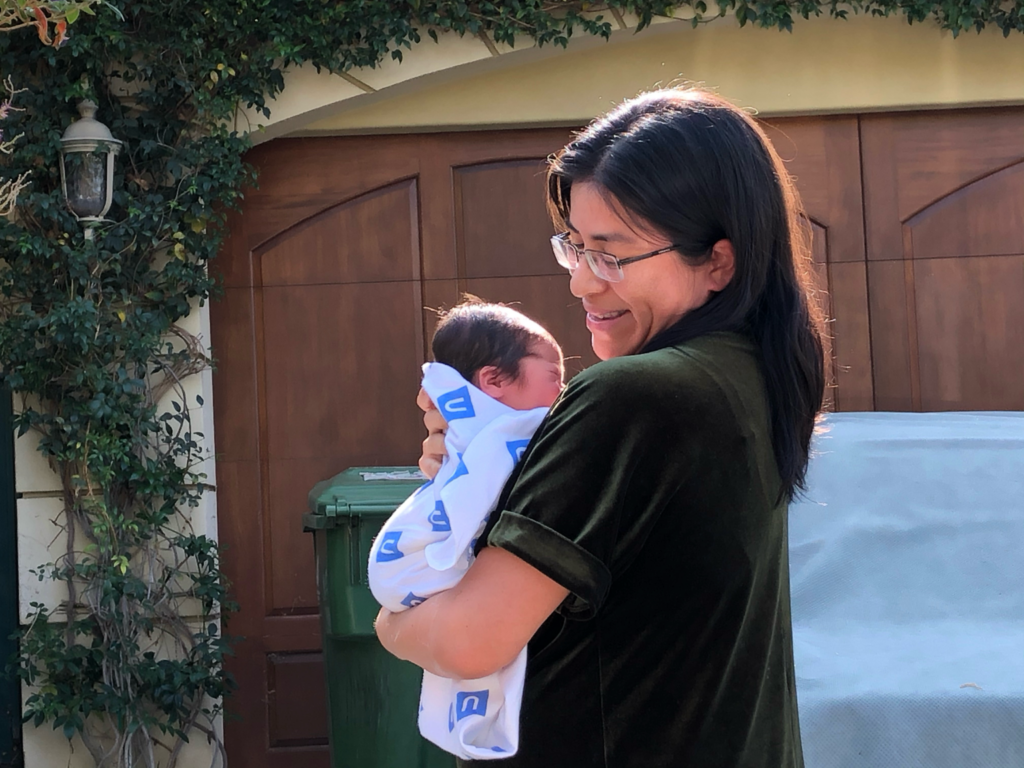
The day I brought my first son home from UCLA Santa Monica Medical Center to Pacific Palisades. It was a very special beginning to my journey as a mom.
After the fire displaced my family, people from that community showed my children and me tremendous kindness. We received food, gift cards for essentials and, perhaps most importantly, emotional support during an incredibly difficult time.
That kindness stayed with me.
A few months later, I began volunteering periodically with the children’s Sunday school program. I especially love volunteering around my own children’s classes because I want my kids not only to hear me talk about helping others, but to see me doing it.
They are so proud when Mommy is volunteering at their Sunday school. And I have to admit, I’m pretty happy about it too.
What Does Any of This Have to Do With Real Estate?
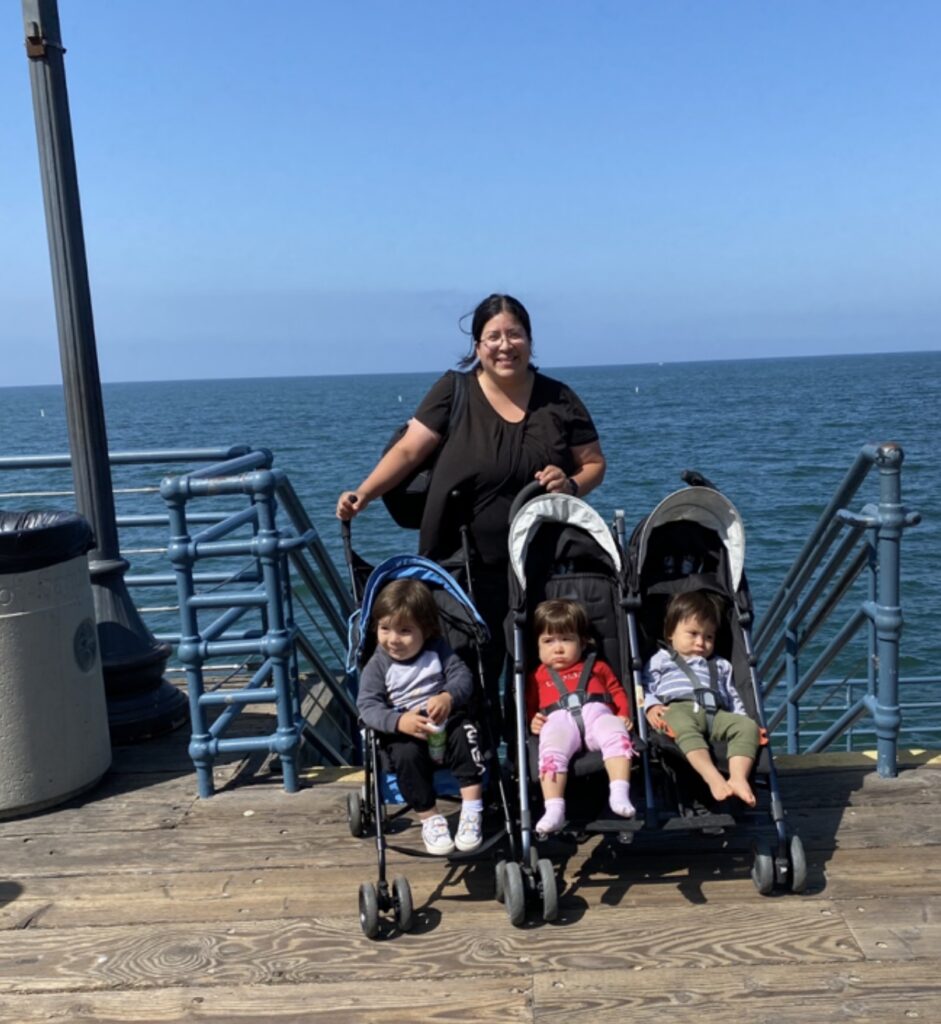
Enjoying a beautiful day at the Santa Monica Pier with my three kiddos: one of many family memories we’ve made on the Westside.
Actually, quite a lot.
Real estate is ultimately about much more than square footage, interest rates and comparable sales.
It’s about people’s lives.
A home is where someone brings a new baby home. It’s where children grow up. It’s where people celebrate birthdays, have difficult conversations, invite friends over, start businesses at the kitchen table and build memories that may last much longer than the house itself.
That’s one reason I approach my work as a California real estate broker serving neighborhoods such as Santa Monica throughout the Westside of Los Angeles, as well as Pacific Palisades, with a service-first mindset.
I also believe homeowners deserve options.
Not every seller needs exactly the same level of real estate service. Some want comprehensive representation from beginning to end. Others are experienced, capable sellers who may want MLS exposure and more control over the process. Still others fall somewhere in between. My role isn’t to force every homeowner into the same box. It is to listen, explain the options clearly and help people decide what makes sense for their particular situation.
Looking Forward
Santa Monica isn’t exactly the city I remember from my college days or those lunchtime walks years ago.
But perhaps no city ever stays exactly the same.
There are real challenges here, and there are also families building lives, students planning their futures, small businesses taking chances, longtime residents who care deeply about their neighborhoods, and communities of people helping one another.
I’ve experienced that generosity personally.
It is one of the reasons I am grateful to serve neighborhoods throughout the Westside of Los Angeles, including Santa Monica, as well as Pacific Palisades, as a local real estate broker.
For me, real estate is a business – but being of service to people is the bigger purpose behind it.
With gratitude and a heart for service,
Claudia Backus, MBA
California Real Estate Broker | REALTOR® Serving Pacific Palisades & the Westside
By Claudia Backus, MBA | California Real Estate Broker | REALTOR®
I have called Pacific Palisades home for close to two decades, but January 7, 2025 changed what “home” means to me. That morning I went to work in Santa Monica while my three young children went to preschool in Venice, just like any other day. By the end of that day, our lives had changed in ways I could never have imagined.
The Palisades Fire partially damaged our home and displaced my children and me for 16 months. What I thought would be a temporary interruption became more than a year of waiting, repairing and trying to create some sense of normal life for three little children who simply wanted to know when they could go home.
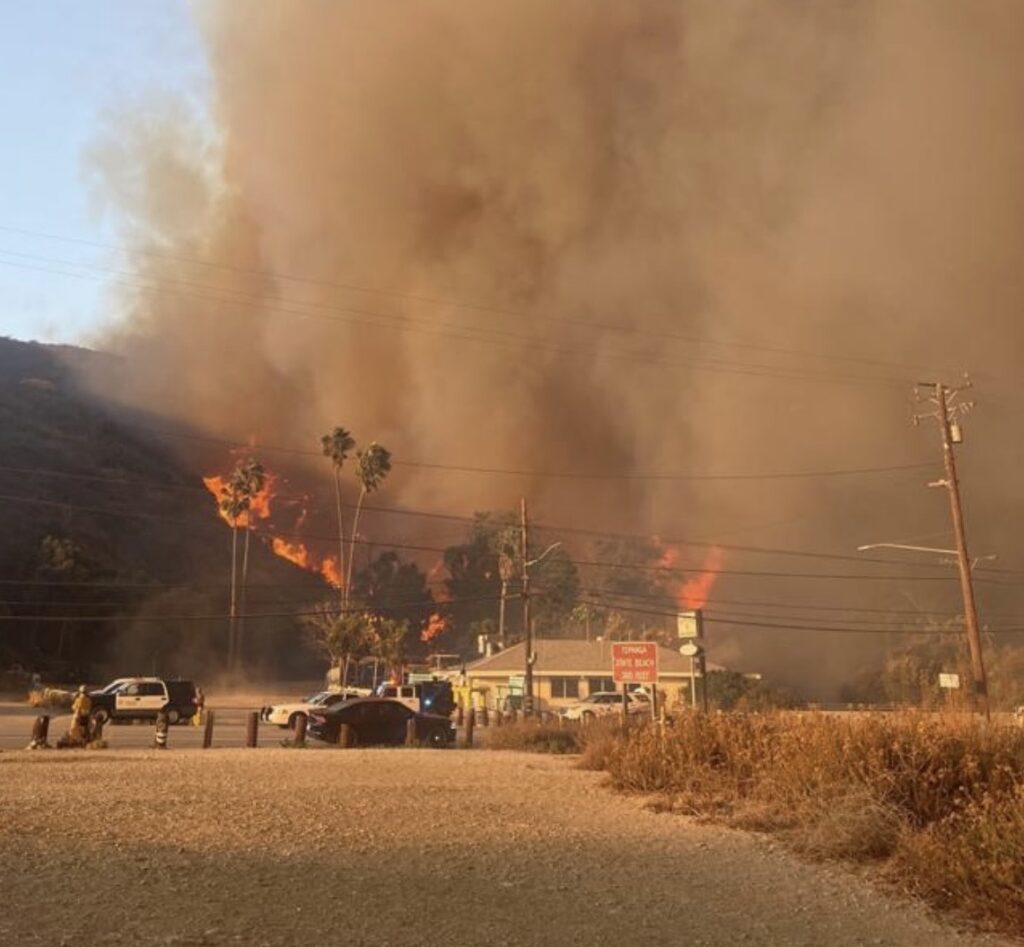
The Palisades Fire, January 2025. Photo from my personal collection.
In the beginning, my children did not understand why we couldn’t just go home, sleep in our own beds or play with their toys. For a while, I told them we were on vacation.
Eventually, I wanted to be honest with them in a way they could understand. I explained that there had been a big fire in Pacific Palisades and that lots of “Bob the Builders,” as we called them, were coming to help turn off the fires and rebuild our beautiful community one home at a time. They understood as much as small children could. But for months, when I picked them up from school, they would ask me the same simple question: “Mom, which house are we going to today?”
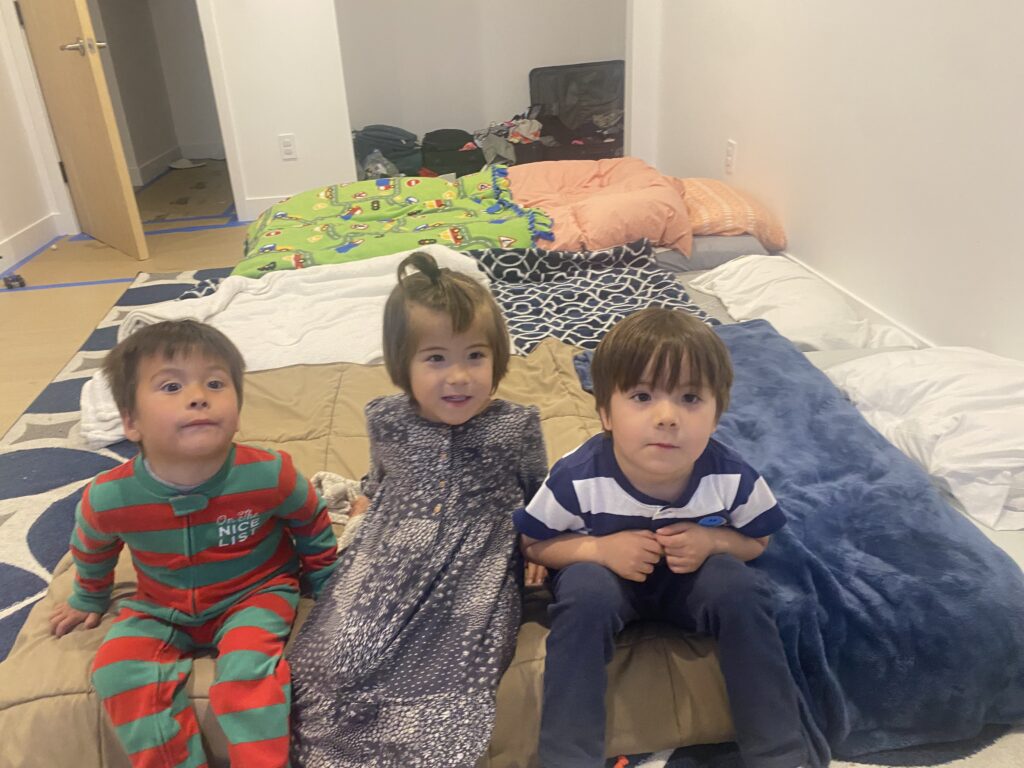
Our “home” in Westwood for about 16 months. Three mattresses on the floor and donated clothes for the four of us.
A Season of Incredible Kindness
There was a time during those months when I felt homeless and hopeless. We slept together on mattresses on the floor. We wore donated clothing. My children played with donated toys. We ate food generously provided by the YMCA and other organizations helping families affected by the fire.
At the same time, I witnessed something I will never forget. Friends, family, churches, nonprofits, local organizations and complete strangers stepped forward to help. They brought food, clothes, gift cards, school supplies and emotional support. Professionals donated their time and shared their knowledge. People checked on us and on one another.
During the same period that we lost the ability to live in our home, I also lost my job. I have always been a very independent person, and asking for help did not come naturally to me. But there came a point when I had to accept that I needed help, and I stopped feeling ashamed about asking for it.
That experience changed me. I started noticing the good in people much more than I noticed the bad. I became less interested in things and more interested in experiences and memories with my children. I became more grateful for ordinary days, because after you spend months wondering when you will be able to go home again, an ordinary day at home feels pretty extraordinary.
Most importantly, I wanted my children to learn from what had happened to us. I wanted them to see that difficult things happen in life, but that we can keep moving forward. I wanted them to learn kindness and gratitude through our actions, not simply because I told them those things were important.
Coming Back to Pacific Palisades
When we finally came home after 16 months, I returned to the same community, but I saw it differently.
There are still many empty lots throughout Pacific Palisades. Some streets are filled with construction trucks and workers. There is dust. There are nails and debris on the roads. I have already had two tires damaged by nails since coming back. Rebuilding an entire community is messy, noisy and inconvenient.
But when I drive through Pacific Palisades, that is not all I see. I see homes being rebuilt. I see businesses trying to recover. I see neighbors sharing information and helping each other navigate insurance, permits and construction. I see coalitions, nonprofits, churches and community organizations continuing to offer resources even long after the fire.
There are free community events, mental health resources, exercise classes, informational meetings and conversations about rebuilding and recovery. Accountants, attorneys and other professionals have volunteered their knowledge and, in some cases, their services.
And there is something special about seeing another family come home. We celebrate comeback stories because we understand what it took to get there. I find myself wanting to read local Pacific Palisades news because these stories are about people and places I recognize. They are about our neighbors and our community.
Of course, not everyone has experienced the aftermath of the fire in the same way. There is frustration, sadness and anger too, and understandably so. Families lost homes, belongings, businesses, jobs and a sense of security. Some people are still waiting for answers and making very difficult decisions about what comes next.
This is simply what I have noticed through my own experience. Maybe going through the fire changed what I choose to notice.
Rebuilding Is About More Than Houses
Since returning, I have also become much more intentional about where I spend my money. If I can buy groceries in Pacific Palisades, I do. If I am meeting someone for coffee, I try to meet them here. When I need a gift, I like buying gift cards from local businesses.
These are small decisions, but I now understand that rebuilding Pacific Palisades is about much more than rebuilding houses. A community also needs its restaurants, coffee shops, stores, schools, churches, organizations and local businesses. It needs families walking around again. It needs children playing. It needs people spending money locally. It needs people who believe there is a future here.
That brings me to something I think about often now: What is Pacific Palisades becoming?
I don’t think anyone knows the complete answer yet.
What Does This Mean for Pacific Palisades Real Estate?
As a California real estate broker and a Pacific Palisades resident, I look around and see a real estate market going through something very unusual.
There are homeowners who are determined to rebuild. There are others who may decide that after everything they have been through, they simply cannot or do not want to go through a lengthy rebuilding process. Some may decide to sell their lots.
Some families will come back. Some will decide to stay in the communities where they lived while displaced. Some may sell surviving homes and start somewhere new.
At the same time, there are buyers who want to live in Pacific Palisades and investors looking at vacant lots, new construction and opportunities created by a neighborhood that will be changing for years.
Every one of those decisions becomes part of the future real estate landscape of Pacific Palisades.
An empty lot is not just an empty lot. Behind it may be a family trying to decide whether to rebuild the home they loved, sell the property, wait, or take their lives in a completely different direction.
A new house being built is not simply new construction. It is another piece of a neighborhood coming back. And someone buying a home or lot here today is buying into a community that is still rebuilding around them.
That means buyers need to ask different questions. What is being rebuilt nearby? How might years of construction affect a particular street? What should they understand about insurance? What is planned for surrounding lots?
Sellers have different questions too. Should they rebuild before selling? Should they sell the lot? What is the land worth today? Who is buying? What are other properties actually selling for? What options do they have if they want MLS exposure but do not need traditional full service representation?
There is no single answer that is right for everyone. And I think that is exactly why good real estate guidance matters right now.
The Fire Changed My Why
The fire changed many things in my life, including why I want to use my real estate experience and knowledge to serve others. My purpose as an independent real estate broker is to help people understand their options and make informed real estate decisions, especially during a time when so many families and property owners in our community are deciding what comes next.
I am an independent real estate broker, but I am also a mom raising three children in Pacific Palisades. I shop here. I drive these streets. I see the construction. I see the empty lots. I see families coming back. I also know what it feels like to wonder when, or if, life will ever feel normal again.
My goal is not to tell every homeowner that they should sell or every buyer that they should buy. My goal is to serve people by helping them understand their real estate options.
That might mean helping a homeowner sell a house or vacant lot. It might mean helping someone understand what similar properties have sold for before deciding what to do. It might mean helping a buyer find a home here. It might mean working with an investor who sees an opportunity to build. And because I am an independent broker, I can offer different levels of real estate service and pricing depending on what a client actually needs.
That is also one of the reasons I am starting this blog. I want to write about the real questions people are asking about real estate in Pacific Palisades and the Westside. I want to research those questions, explain what I learn in plain English and share information that can help homeowners, buyers and investors make informed decisions.
I don’t know exactly what Pacific Palisades will look like five or ten years from now. But I know what I see today.
I see empty lots next to homes where families have returned. I see construction crews rebuilding one property at a time. I see local businesses trying to make it. I see neighbors checking on neighbors. I see families celebrating when they finally come home.
And when I look at my own three children sleeping in their own beds again, surrounded by their own toys, I understand just how much the word “home” can mean.
After almost two decades of living in Pacific Palisades, I thought I already knew this community. It took losing our home for 16 months to make me realize how much this community truly feels like home.
Claudia Backus, MBA California Real Estate Broker | REALTOR® Pacific Palisades, California
If you are thinking about buying or selling a home or lot in Pacific Palisades or the Westside, or you simply do not know what your next real estate step should be, I am happy to talk through your options with you.