If you are thinking about selling your home, you have probably asked some version of the question, “What is my house worth?” Today, homeowners can find estimates online in seconds, but understanding how a home fits into the current market usually requires more than one automated number.
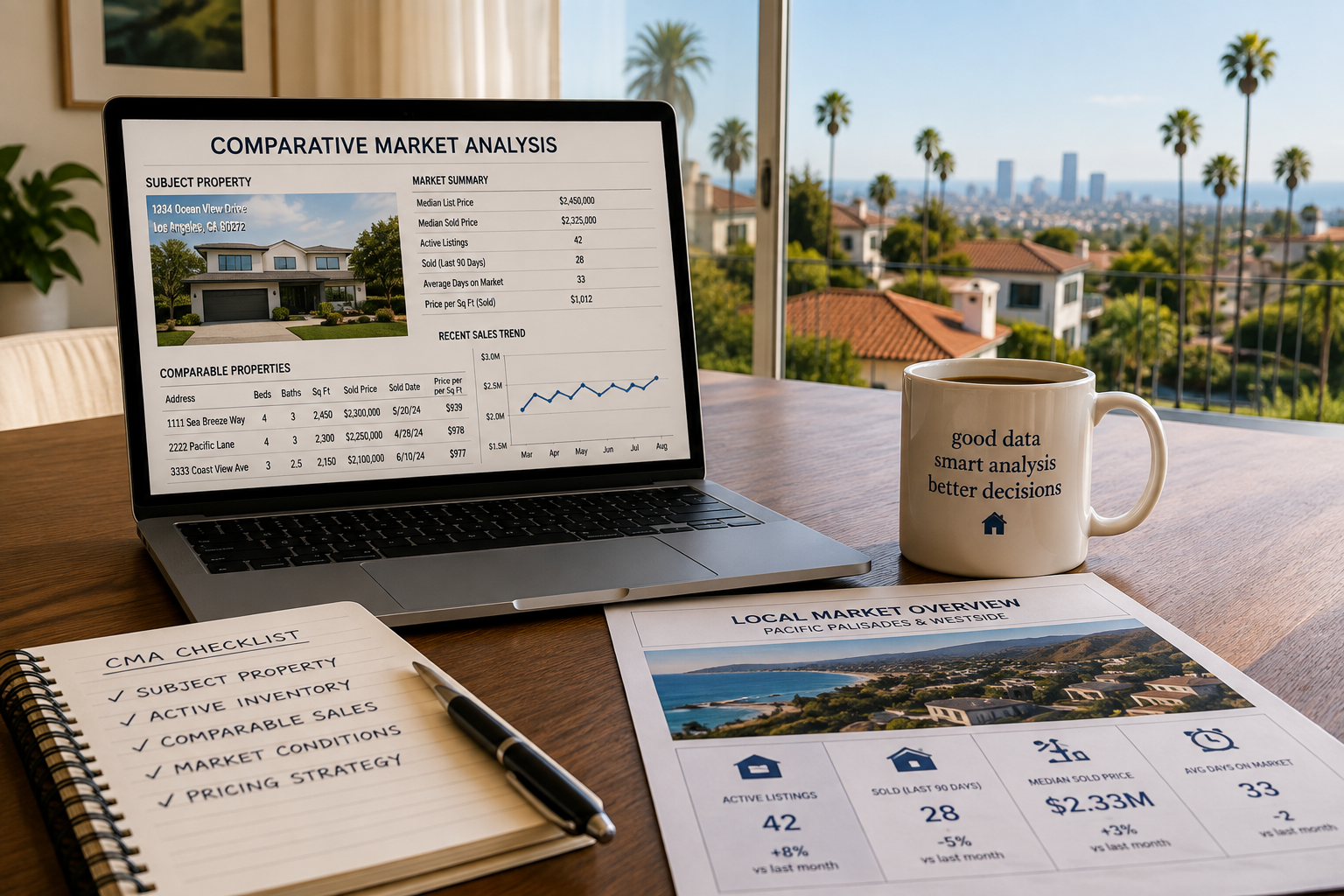
A Comparative Market Analysis, commonly called a CMA, is one of the tools real estate professionals use to help answer that question. A thoughtful CMA looks at relevant properties, current market conditions, active competition, and the characteristics of a specific home to help a homeowner understand a reasonable pricing range and begin thinking about a selling strategy.
As a mom of three young children, the word “homework” has taken on a whole new meaning in my life. But there is another kind of homework I have come to appreciate in real estate: the work that should happen before advising someone about the value and pricing of their home. To me, a good CMA is exactly that kind of homework.
What Is a CMA in Real Estate?
A CMA is an analysis of comparable properties and market conditions used to help estimate how a home may compete in the current real estate market. It usually includes recent sales, but a good analysis goes beyond finding a few homes nearby and averaging their sale prices.
The goal is to identify properties that are meaningfully comparable and then understand the differences. Location, size, condition, renovations, lot characteristics, views, layout, privacy, and other property specific details can all affect how buyers perceive value. Two homes can be close to one another and still compete very differently in the market. This is one reason I believe a CMA should be researched rather than simply generated. The data matters, but so does deciding which data is actually relevant.
Why Does a CMA Still Matter When We Have Online Home Estimates?
Homeowners now have access to more real estate information than ever before, and I think that is a good thing. Online valuation tools can be useful as a starting point, and artificial intelligence is creating even more ways to organize and analyze information. I use technology myself and enjoy learning how these tools can help us work more intelligently.
But an estimate and an analysis are not quite the same thing. An automated tool may not fully understand a remodeled kitchen, an unusual floor plan, the quality of a view, the condition of a property, or why buyers may respond differently to two homes that look similar on paper. A CMA gives us an opportunity to look at the data in the context of the actual property and the market around it.
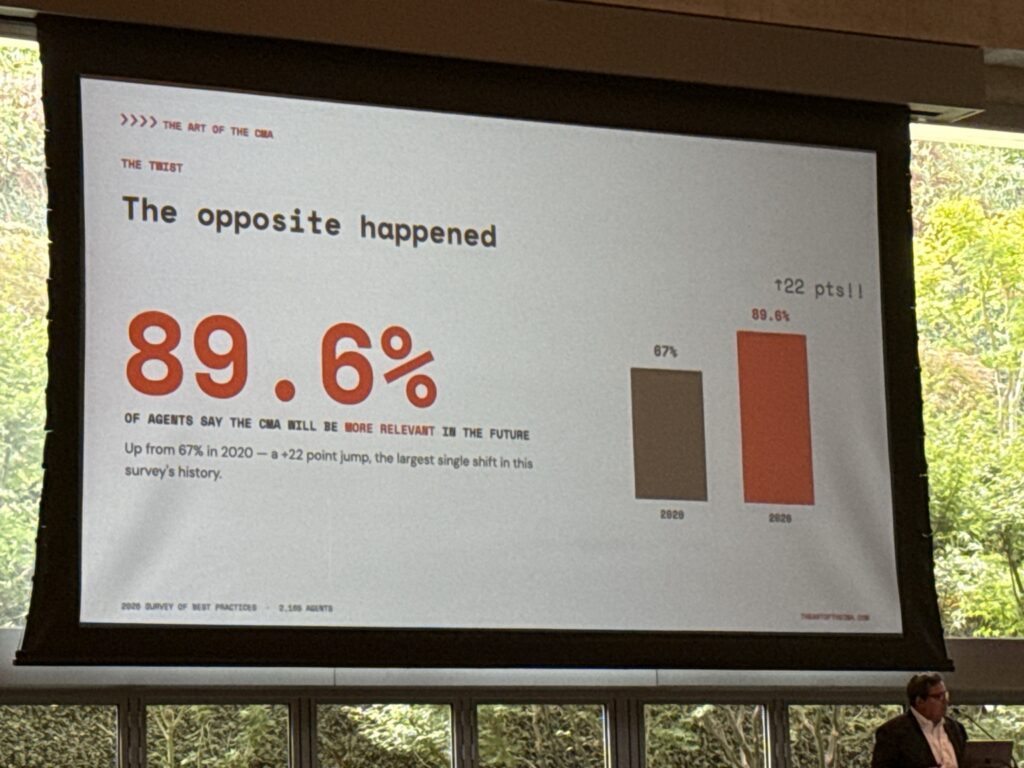
That distinction became even clearer to me at The MLS Summit 2026. As public real estate data and AI tools continue to grow, I do not think the professional role becomes less important. I think the responsibility shifts toward understanding the information, verifying it, interpreting it carefully, and explaining it clearly to the homeowner.
A CMA Is More Than Looking at Sold Homes
One of my favorite practical takeaways from the Summit was the importance of looking closely at active inventory. Sold properties tell us what buyers were willing to pay in the recent past, which is important, but active listings tell us what a buyer can choose today.
If you are preparing to sell, your home is not only being compared with properties that sold three months ago. It will compete with the homes buyers can tour and consider right now. Understanding that active competition can help put pricing, condition, presentation, and strategy into perspective.
This is also where the idea of a micro market matters. Asking “How is the Los Angeles market?” is often too broad to be very useful for one homeowner. The more helpful question is: what is happening in the particular market in which this particular home will compete? Price range, neighborhood, property type, size, condition, and buyer expectations can create very different markets within the same city.
A Home Is Not Just a Collection of Data
A CMA depends on data, but a home is not simply a collection of numbers. This is where professional judgment and local context become important. How does the home compare with the competition buyers are seeing right now? Which comparable properties are truly comparable? Does a renovation add the value a homeowner expects it to add? How might buyers respond to the condition, layout, lot, view, privacy, or location?
Those questions do not mean the data is less important. They mean the data needs to be interpreted. A good CMA should help a homeowner understand not only what the numbers say, but why certain properties are more relevant than others and what those comparisons may mean for the home’s position in the market.
Pricing Can Be Personal
Pricing a home is both analytical and personal. For many homeowners, a house represents far more than an investment. It may be where children grew up, where holidays were celebrated, where years of improvements were made, or simply a place filled with memories. It makes sense that conversations about value can carry emotion.
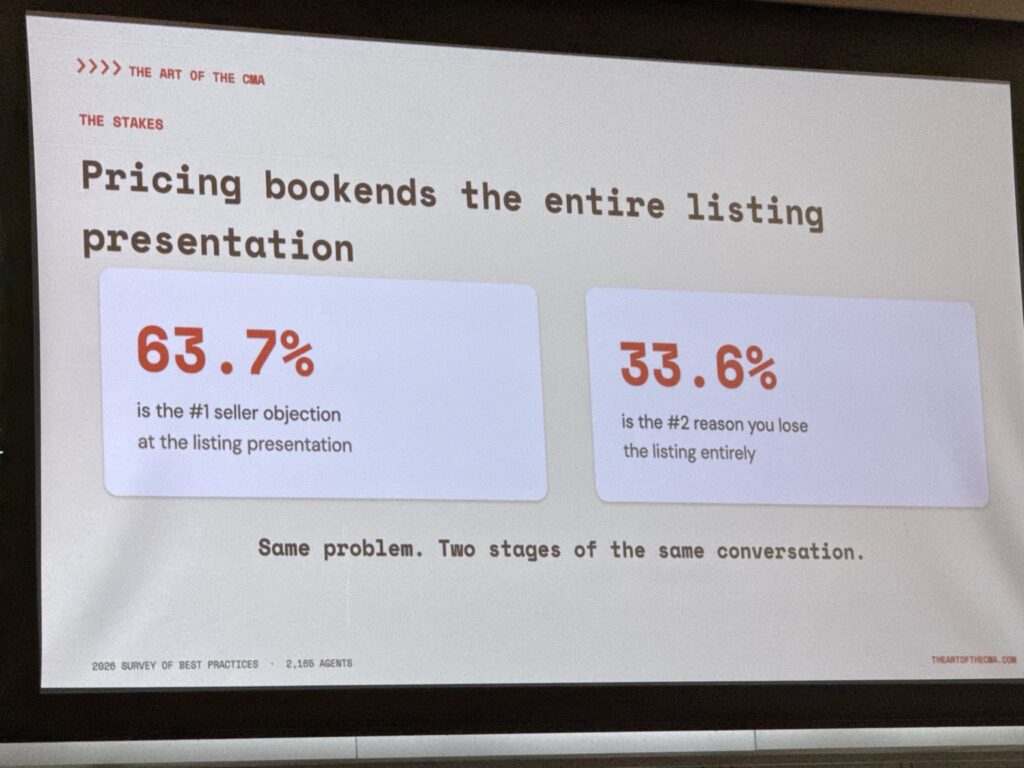
Pricing was a major theme during the CMA discussion at The MLS Summit 2026. The presentation shared survey data showing that pricing was the number one seller objection at a listing presentation, reported by 63.7 percent of surveyed agents. I do not interpret that statistic as homeowners being difficult. I see it as a reminder of how important it is for a real estate professional to arrive prepared and be able to explain the evidence behind a pricing recommendation.
A CMA Is a Starting Point for a Conversation
I do not think the purpose of a CMA is to walk into someone’s home, announce a number, and end the conversation. The more useful approach is to walk through the information together. Which properties were selected as comparables? Why were they selected? What is currently competing for buyers’ attention? Where is the subject property stronger or weaker? What has changed in the market?
The homeowner’s goals matter too. One seller may prioritize achieving the highest possible price and have flexibility with timing. Another may need to move within a certain period. Someone else may value privacy, simplicity, or certainty. The market data helps inform the strategy, but the strategy should also reflect the person making the decision.
That is why I like thinking of a CMA as the beginning of a thoughtful pricing conversation rather than a final verdict on what a home is worth.
Doing the Homework Before Selling
The more I learn about real estate, the more I appreciate how much responsibility comes with giving someone guidance about their home. A CMA may begin with numbers, but its purpose is not simply to produce a number. It is to help a homeowner understand the market, ask better questions, and make a decision with more information and confidence.
To me, that is what doing the homework is really about. If someone trusts me enough to ask for guidance about one of their largest assets, I want to come prepared, keep learning, explain what I see as clearly as I can, and do my best to be of service.
Claudia Backus, MBA, REALTOR®
California Real Estate Broker
Serving Pacific Palisades & the Westside